
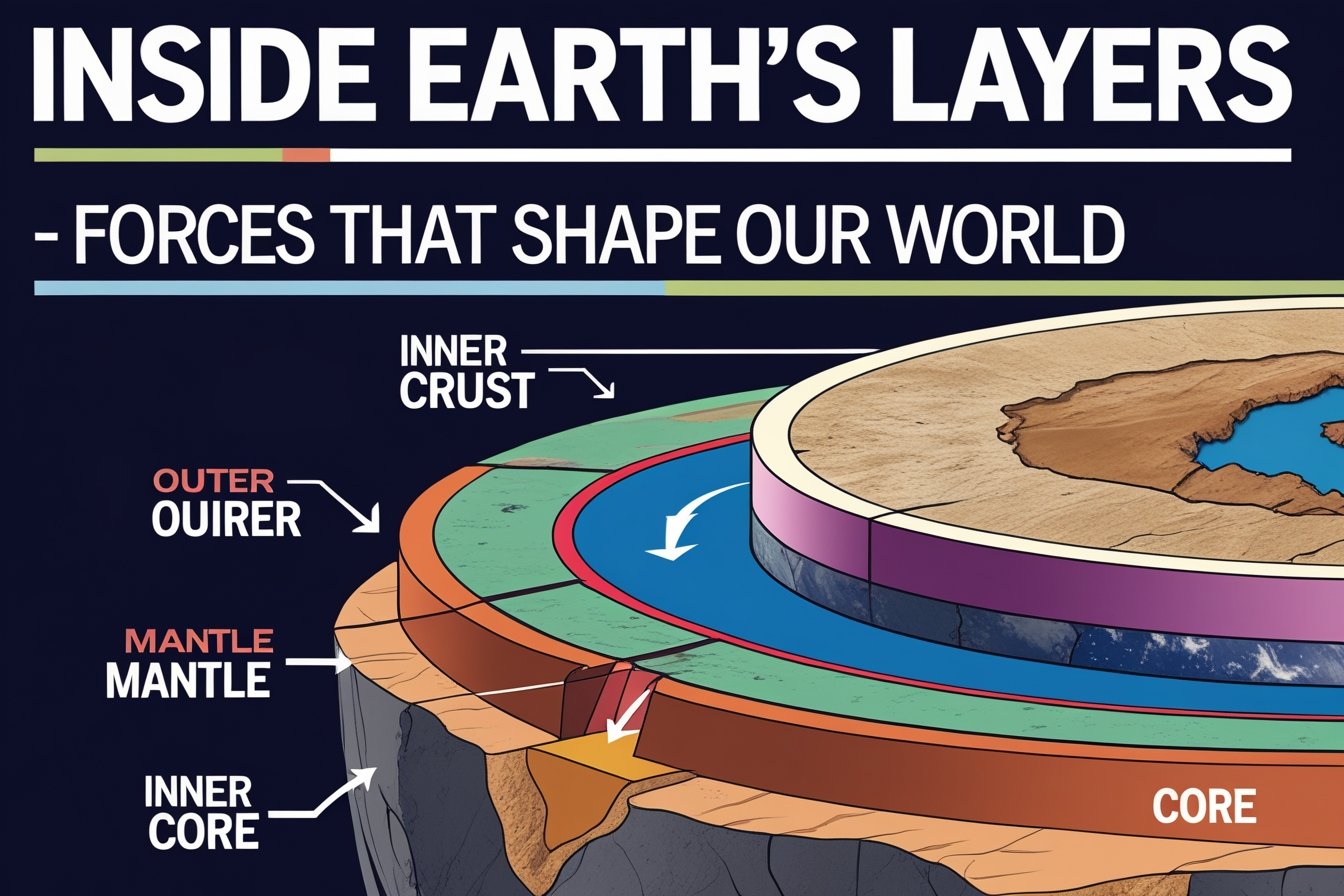
Have you ever wondered what’s happening thousands of miles beneath your feet right now? While you’re reading this, an extraordinary drama is unfolding in the deepest parts of our planet, a story of immense pressures, scorching temperatures, and dynamic forces that have been sculpting our world for over 4.5 billion years. Earth’s layers aren’t just static zones stacked like a layer cake; they’re active, interconnected systems where powerful geological forces work tirelessly to create the mountains we climb, the valleys we explore, and even the ground we walk on every single day.
The Hidden Engine Room 6,000 Miles Below:
Deep within Earth’s core, something remarkable is happening that most people never think about. Imagine a ball of molten iron and nickel spinning at temperatures hotter than the surface of the sun – that’s our planet’s inner core. This isn’t just a random hot spot; it’s the engine that powers everything from volcanic eruptions in Hawaii to the northern lights dancing across Arctic skies.
The core’s heat creates a constant flow of energy that travels upward through each layer of our planet. This energy doesn’t just sit there – it moves, flows, and creates the dynamic processes that have shaped every landscape feature we’ve ever seen. Without this internal furnace, Earth would be a cold, dead rock floating through space with no magnetic field to protect us from harmful cosmic radiation.
What makes this even more fascinating is that scientists have never directly observed the Earth’s core. Everything we know comes from studying earthquake waves as they travel through the planet. These seismic waves speed up, slow down, and change direction as they encounter different materials, creating a kind of X-ray vision that reveals the hidden architecture of our world.
The core’s magnetic field generation is perhaps its most crucial function for life on Earth. As the liquid outer core swirls around the solid inner core, it creates electrical currents that generate our planet’s protective magnetic shield. This invisible barrier deflects dangerous solar particles that would otherwise strip away our atmosphere and make life impossible.
When Rock Flows Like Honey:
The Earth’s mantle behaves in ways that challenge our everyday understanding of solid rock. Under extreme pressure and temperature, solid rock actually flows like thick honey – a process that takes thousands of years but never stops. This slow-motion dance of flowing rock creates the forces that push continents around like puzzle pieces on the planet’s surface.
Convection currents in the mantle work like a massive, slow-motion conveyor belt system. Hot rock rises from deep within the Earth, spreads out beneath the surface, cools down, and then sinks back toward the core. This cycle has been operating continuously for billions of years, and it’s the primary force behind plate tectonics.
The mantle contains most of Earth’s volume – about 84% of the planet’s total mass. Despite being solid, the mantle’s rock is hot enough to glow if you could see it, with temperatures reaching up to 7,000 degrees Fahrenheit. This heat comes from two sources: leftover energy from Earth’s formation and radioactive decay of elements like uranium and thorium.
When mantle material finds weak spots in the crust above, it can break through to create volcanic activity. The Hawaiian Islands exist because of a mantle plume – a column of extra-hot rock that has been punching through the Pacific Plate for millions of years, creating a chain of volcanic islands as the plate moves over this stationary hot spot.
Where Drama Meets Daily Life:
Earth’s crust might be the thinnest layer, but it’s where all the action happens that directly affects human civilization. This outermost shell is constantly being created, destroyed, and recycled through processes that operate on timescales far longer than human history but with effects we can observe in real-time.
Crustal movements create the spectacular geological features that define our planet’s character. The Himalayas continue growing taller each year as the Indian plate crashes into the Eurasian plate. The San Andreas Fault in California represents an active boundary where two massive pieces of crust are grinding past each other, storing up energy that periodically releases in earthquakes.
The oceanic crust tells a different story from the continental crust. Ocean floors are relatively young – none older than about 200 million years – because they’re constantly being recycled. New oceanic crust forms at mid-ocean ridges where mantle material rises up and solidifies, while old oceanic crust gets pushed back down into the mantle at deep ocean trenches.
Continental crust is much older and more complex, containing rocks that are billions of years old. These ancient rocks preserve evidence of Earth’s early history, including signs of the first life forms and clues about how our atmosphere and oceans developed. The story of life on Earth is literally written in the rocks beneath our feet.
The Great Recycling Machine:
One of the most mind-blowing aspects of Earth’s layers is how they work together as a giant recycling system. The rock cycle means that the mountains of today will become the ocean floors of tomorrow, and the ocean floors of today will become the mountains of the distant future. This constant recycling has been operating for billions of years and will continue long after human civilization is gone.
Subduction zones represent the most dramatic part of this recycling process. Here, entire sections of the ocean floor – complete with sediments, water, and sometimes even living organisms – get dragged down into the mantle where they’re melted and reformed. The materials that make up your body may have been part of ancient mountains, deep ocean sediments, or even other living creatures millions of times over.
This recycling process explains why Earth has remained geologically active while other planets like Mars appear to be geologically dead. The continuous exchange of materials between Earth’s layers keeps our planet’s internal heat engine running and maintains the dynamic processes that make our world so geologically interesting.
Volcanic activity serves as one of the main ways that deep Earth materials return to the surface. When volcanoes erupt, they’re not just creating spectacular displays – they’re bringing materials from the mantle back to the surface, often carrying valuable minerals and elements that have been processed in the deep Earth’s high-pressure, high-temperature environment.
Reading Earth’s Internal Communications:
Every earthquake represents a message from deep within Earth’s layers about the ongoing processes happening far beneath the surface. Seismic waves travel through the planet at different speeds depending on the materials they encounter, and scientists have learned to read these waves like a complex language that reveals the hidden structure of our world.
P-waves (primary waves) can travel through both solid and liquid materials, while S-waves (secondary waves) can only travel through solids. When earthquake waves reach the outer core, S-waves disappear entirely because the outer core is liquid. This discovery in the early 1900s provided the first direct evidence that part of Earth’s core is molten.
The behavior of earthquake waves also revealed the existence of different zones within the mantle. Some regions where waves slow down indicate partially molten rock, while areas where waves speed up suggest cooler, more solid material. These discoveries help scientists understand how heat flows through the planet and where convection currents are most active.
Deep earthquakes – those occurring more than 400 miles below the surface – can only happen in specific conditions. They provide evidence of cold, solid slabs of oceanic crust being dragged down into the hot mantle at subduction zones. These deep earthquakes trace the paths of descending plates and help scientists map the three-dimensional structure of plate boundaries.
Our Planet’s Invisible Protector:
Earth’s magnetic field represents one of the most crucial but invisible forces generated by the interaction between Earth’s layers. This magnetic shield extends far into space and deflects most of the dangerous radiation that streams constantly from the sun. Without this protection, Earth’s atmosphere would gradually be stripped away, just like what happened to Mars billions of years ago.
The magnetic field isn’t constant – it fluctuates in strength and even reverses direction periodically. Magnetic north has been wandering across the Arctic at an accelerating pace, and the overall strength of the field has been decreasing for the past 150 years. Scientists monitor these changes carefully because they could affect everything from navigation systems to power grids.
Magnetic reversals have happened hundreds of times throughout Earth’s history, with the magnetic north and south poles completely flipping positions. During these reversals, which can take thousands of years to complete, the magnetic field becomes much weaker and more complex, potentially allowing more cosmic radiation to reach Earth’s surface.
Evidence of past magnetic reversals is preserved in rocks that contain magnetic minerals. When these rocks formed, the magnetic minerals aligned with Earth’s magnetic field at that time, creating a permanent record of ancient magnetic directions. This magnetic fingerprint has been crucial for understanding plate tectonics and confirming that continents have moved across Earth’s surface.
Chemical Factories Operating Under Extreme Conditions:
The extreme conditions within Earth’s layers create chemical environments that don’t exist anywhere else in our solar system. The combination of intense pressure, extreme temperature, and the presence of water and various minerals creates natural laboratories where new compounds form and existing materials transform in remarkable ways.
High-pressure minerals that form deep in the mantle sometimes make their way to the surface through volcanic eruptions, providing samples of materials that have been processed under conditions equivalent to millions of times atmospheric pressure. Diamonds are perhaps the most famous example – they form at depths greater than 90 miles and can only reach the surface through explosive volcanic events.
The chemical differentiation of Earth’s layers happened early in our planet’s history when the entire planet was largely molten. Heavy elements like iron and nickel sank toward the center, while lighter elements rose toward the surface. This process created the distinct chemical signatures of each layer and established the basic architecture that still governs how our planet works today.
Water circulation between Earth’s layers plays a crucial role in many geological processes. Water trapped in minerals can be carried down into the mantle at subduction zones, where it affects melting temperatures and helps generate volcanic activity. Some scientists estimate that the mantle contains several times more water than all the oceans combined, though it’s locked up in the crystal structure of minerals.
Rocks That Tell Ancient Stories:
Every rock on Earth’s surface has a story to tell about the forces that created it and the journey it has taken through Earth’s layers. Some rocks preserve evidence of conditions that existed billions of years ago, while others are so young they’re still forming today. Learning to read these stories provides insights into how our planet has changed over vast periods.
Metamorphic rocks represent materials that have been transformed by the heat and pressure they encountered during journeys through different parts of Earth’s layers. The minerals and textures in these rocks provide direct evidence of the temperatures and pressures they experienced, allowing scientists to map the paths they traveled within the Earth.
Igneous rocks tell stories about conditions in the mantle and core where they originated. The chemical composition of volcanic rocks reveals information about the source materials deep within the Earth and the processes that brought them to the surface. Some volcanic rocks contain xenoliths – pieces of mantle rock that were torn loose and carried upward during eruptions, providing direct samples of materials from Earth’s interior.
Sedimentary rocks preserve evidence of surface conditions throughout Earth’s history, including climate changes, life evolution, and the effects of geological forces on landscapes. The story of Earth’s changing surface is written in layers of sedimentary rock that accumulated over millions of years in ancient oceans, lakes, and river systems.
Conclusion:
The forces operating within Earth’s layers represent one of nature’s most impressive engineering projects, a self-sustaining system that has been operating continuously for over 4.5 billion years. From the spinning iron core that generates our protective magnetic field to the slow-motion dance of mantle convection that moves continents, every layer plays a crucial role in making Earth the dynamic, living planet we call home.
FAQs:
1. How deep have humans actually drilled into Earth’s layers?
The deepest human drilling reached only 7.5 miles into the Earth’s crust, less than 0.2% of the way to the center.
2. What would happen if Earth’s core stopped spinning?
Earth’s magnetic field would disappear, leaving us vulnerable to deadly solar radiation and atmospheric loss.
3. How fast do tectonic plates actually move?
Crustal plates move at about the same rate as your fingernails grow – roughly 2-4 inches per year.
4. Can we predict when the magnetic poles will reverse again?
Scientists cannot predict when the next magnetic reversal will occur, though the field is currently weakening.
5. Why doesn’t the immense pressure in Earth’s core crush everything?
The inner core remains solid despite extreme heat because pressure increases faster than the melting point at those depths.
6. How do scientists know what’s inside Earth without digging there?
Earthquake waves act like X-rays, revealing Earth’s internal structure by changing speed through different materials.