
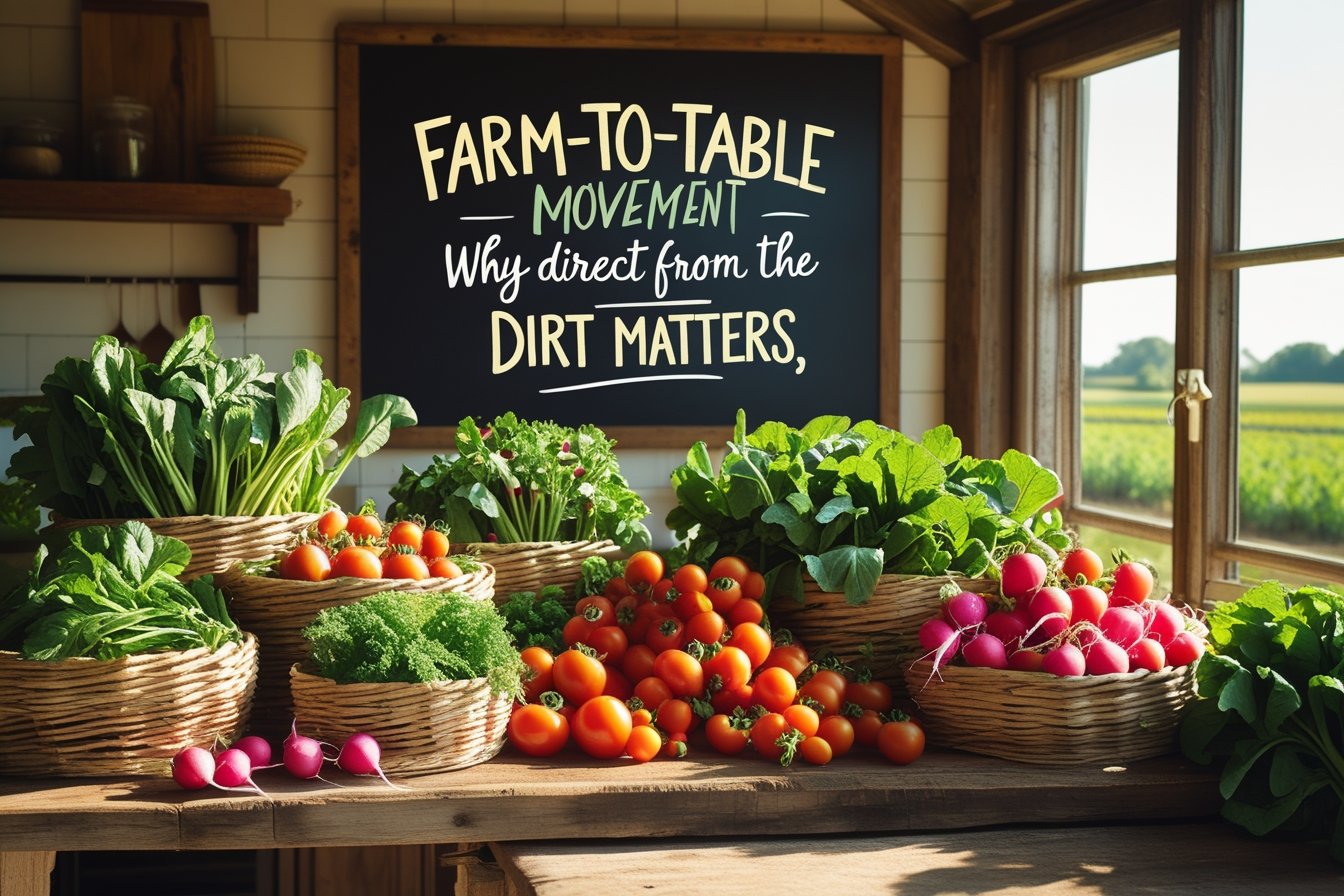
Your grandmother’s tomato still haunts your taste buds, doesn’t it? That perfect balance of sweetness and acidity that today’s grocery store imposters can’t replicate? The farm-to-table movement isn’t just about eating local, it’s about reclaiming the authentic flavors that industrial agriculture stole from our plates. When food travels direct from the dirt to your dinner table, everything changes: taste, nutrition, community connections, and even your relationship with the planet itself.
The Flavor Archaeology:
Industrial agriculture has systematically bred flavor out of our food in favor of appearance, shelf life, and shipping durability. Farm-to-table dining represents a rebellion against this culinary homogenization, connecting us with heirloom varieties and forgotten flavors that supermarket produce can’t deliver.
Direct sourcing allows farmers to prioritize taste over transportability, growing varieties that would never survive a cross-country journey but deliver explosive flavor experiences. These heritage crops carry genetic diversity and flavor complexity that commercial agriculture abandoned decades ago in pursuit of efficiency and uniformity.
Seasonal eating through local food systems reconnects us with nature’s intended rhythm, where strawberries taste like strawberries only during their brief peak season, making each encounter precious rather than mundane. This temporal scarcity creates appreciation and anticipation that transform eating from routine consumption into a celebratory experience.
Soil connection literally affects flavor chemistry. Plants grown in diverse, healthy soils develop complex mineral profiles and secondary compounds that create nuanced tastes impossible to replicate in sterile, industrial growing media. Direct from the dirt isn’t just marketing, it’s biochemistry.
How Dirt Diversity Feeds the World:
Soil microbiomes represent one of Earth’s most complex ecosystems, containing more organisms in a handful of dirt than humans on the planet. Sustainable farming practices nurture these microscopic communities, which directly influence plant health, nutritional density, and flavor development.
Mycorrhizal networks create underground internet systems connecting plants across farms, sharing nutrients and communication signals that affect everything from pest resistance to mineral uptake. Industrial agriculture disrupts these networks with chemical inputs, while regenerative farming actively cultivates them.
Carbon sequestration through healthy soil practices means that farm-to-table choices directly combat climate change. Every bite from regeneratively farmed soil represents carbon pulled from the atmosphere and stored underground, making dinner choices climate action.
Biodiversity preservation happens naturally when farmers grow for local markets rather than global distribution. Small-scale farming maintains genetic diversity in crops, supports pollinator populations, and preserves beneficial insects that industrial monocultures eliminate.
Knowing Your Food’s Biography:
Food traceability in the farm-to-table system means knowing not just where your food came from, but who grew it, how they treated their soil, what they fed their animals, and what values guided their growing decisions. This agricultural transparency transforms anonymous consumption into a personal relationship.
Farmer partnerships create accountability that industrial supply chains can’t match. When you can visit the farm, meet the grower, and observe the practices firsthand, food integrity becomes verifiable rather than simply marketed. This direct relationship eliminates the multiple intermediaries where quality, ethics, and transparency get lost.
Seasonal storytelling connects each meal to specific moments in agricultural cycles. Your spring asparagus represents the farmer’s winter planning, soil preparation, and patient waiting for perfect emergence. Harvest timing becomes part of the eating experience rather than an invisible industrial process.
Value alignment happens naturally when you can evaluate farming practices personally. Ethical eating becomes possible when you can verify animal welfare, environmental stewardship, and labor practices rather than trusting corporate marketing claims.
Rebuilding Local Wealth Circuits:
Local food economies create what economists call “multiplier effects,” where each dollar spent locally circulates through the community multiple times before leaving the region. Farm-to-table purchasing builds local wealth rather than extracting it to distant corporate headquarters.
Agricultural entrepreneurship flourishes when local markets provide viable income streams for small-scale producers. Direct sales eliminate middleman markups, allowing farmers to earn a living wage while providing consumers with fair prices for premium quality.
Risk distribution through community-supported agriculture (CSA) and direct sales reduces farmer vulnerability to commodity price volatility and corporate contract terms. Financial stability for farmers creates long-term sustainability for local food systems.
Innovation incubation happens naturally in local food networks where farmers can experiment with new varieties, techniques, and products based on direct customer feedback. This agricultural research and development occurs at the community scale rather than corporate boardrooms.
The Health Revolution:
Nutrient density peaks within hours of harvest and degrades continuously during transport and storage. Farm-to-table maximizes nutritional value by minimizing time between harvest and consumption, delivering vitamins, minerals, and phytonutrients at their peak potency.
Probiotic diversity from minimally processed local foods introduces beneficial bacteria that support digestive health and immune function. Industrial processing eliminates these beneficial microorganisms, while farm-fresh foods maintain living ecosystems that nourish our internal microbiomes.
Phytonutrient complexity in plants grown in healthy soils exceeds that of industrially produced foods. Stress responses in plants facing natural challenges create protective compounds that benefit human health, while pampered industrial crops lack these beneficial stress-response chemicals.
Toxic load reduction happens automatically when choosing organic and regenerative farming products that avoid synthetic pesticides, herbicides, and fertilizers. Chemical residue minimization improves long-term health outcomes while supporting farming practices that protect environmental health.
Food as Community Fabric:
Culinary traditions flourish when local ingredients drive menu development rather than global commodity availability. Regional cuisine develops authentically when chefs work with local farmers to showcase terroir-specific flavors and seasonal availability.
Social connections are strengthened through shared investment in local food systems. Community events around farmers markets, harvest festivals, and farm visits create social bonds that extend far beyond food transactions into genuine community relationships.
Educational opportunities multiply when farm-to-table becomes farm-to-school and includes educational programs that connect children with food production. Agricultural literacy creates informed consumers and potential future farmers.
Cultural preservation happens naturally when traditional farming methods and heritage varieties find economic viability through local markets. Agricultural heritage survives when it can compete economically with industrial alternatives.
The Future of Direct Sourcing:
Blockchain technology will soon provide complete food traceability from seed to plate, allowing consumers to verify every aspect of production, processing, and distribution. Digital transparency will make farm-to-table verification instant and verifiable.
Precision agriculture combined with local distribution will optimize growing conditions for flavor and nutrition rather than shipping durability. Technology-enhanced small-scale farming could deliver unprecedented quality and efficiency.
Urban agriculture integration will bring farm-to-table into city centers through vertical farms, rooftop gardens, and community growing spaces. Hyperlocal food production could reduce “direct from dirt” to “direct from neighborhood.”
Climate adaptation through diverse local food systems will provide resilience against global supply chain disruptions. Regional food security through farm-to-table networks creates stability in uncertain times.
Conclusion:
The farm-to-table movement represents more than a dining trend, it’s a return to sanity in our relationship with food, farmers, and the earth itself. When we choose direct from the dirt, we’re not just eating better; we’re voting for a food system that prioritizes flavor over convenience, relationships over anonymity, and sustainability over short-term profits. Every farm-to-table meal is a small revolution, one delicious bite at a time.
FAQs:
Q1: Is farm-to-table more expensive than regular food?
Initial costs may be higher, but nutritional density and reduced healthcare costs often balance expenses.
Q2: How do I find reliable local farms?
Check farmers markets, CSA programs, and online directories for certified local producers.
Q3: Can farm-to-table work in cities?
Yes, through urban farms, rooftop gardens, and local distribution networks serving city markets.
Q4: What’s the environmental impact of farm-to-table?
Reduced transportation, carbon sequestration, and biodiversity preservation create significant environmental benefits.
Q5: How can restaurants verify true farm-to-table sourcing?
Through direct partnerships, farm visits, and transparent supply chain documentation with local producers.
Q6: Does farm-to-table really taste better?
Yes, peak freshness, flavor-focused varieties, and optimal harvest timing create superior taste experiences.